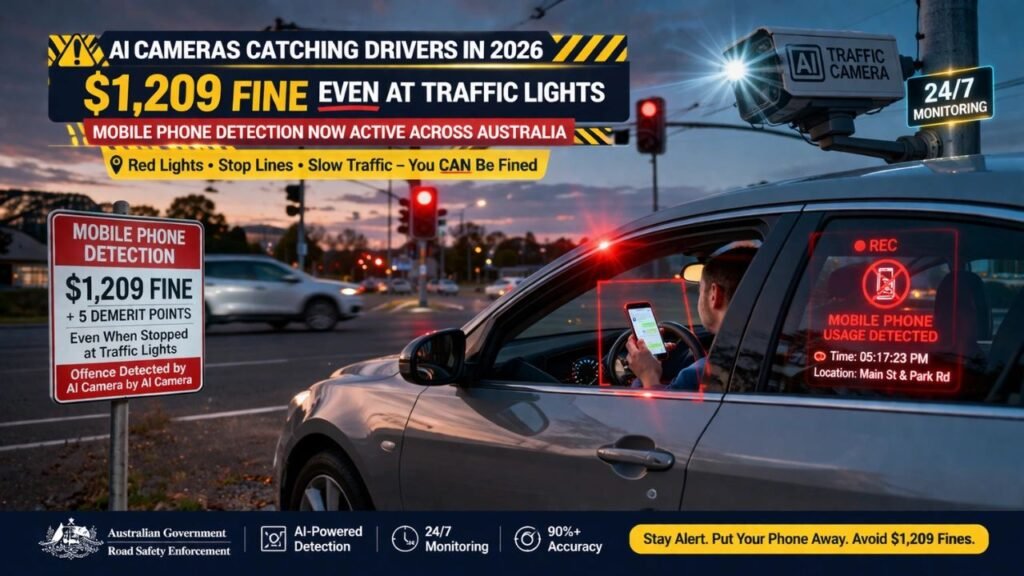
In 2026, road enforcement across Australia is entering a new era powered by artificial intelligence. For drivers, the shift is already becoming noticeable. What once seemed like a harmless habit—glancing at a phone while stopped at a red light—can now lead to a substantial fine of up to $1,209, along with multiple demerit points.
The expansion of AI-powered traffic cameras marks one of the most significant technological upgrades to road safety systems in recent years. These cameras are designed to detect behaviour that was previously difficult to monitor consistently, making compliance with road rules more important than ever.
The Rise of AI Enforcement on Australian Roads
Artificial intelligence is transforming how traffic laws are enforced. Instead of relying solely on police patrols or traditional speed cameras, authorities are deploying advanced imaging systems capable of identifying driver behaviour in real time.
These cameras operate continuously, capturing high-resolution images and analysing them instantly using machine learning technology. The result is a more efficient system that identifies violations with remarkable accuracy.
Key Features of the 2026 Camera Upgrade
The new systems offer capabilities that go far beyond traditional enforcement methods. These include:
- Detection of mobile phone use, even when vehicles are stationary
- Identification of improperly worn or missing seatbelts
- Operation across both urban and regional areas
- Continuous monitoring, day and night
- Automated processing of violations with minimal manual input
- Expanded coverage at intersections and high-traffic zones

This technology represents a shift toward consistent, large-scale monitoring rather than occasional enforcement.
Why Traffic Lights Are Now Under Strict Surveillance
Many drivers assume that once their vehicle stops at a red light, brief phone use is harmless. However, under Australian road laws, drivers remain responsible for their vehicles even while stationary.
AI cameras are specifically targeting intersections because these locations present heightened safety risks.
The Risks of Distraction at Intersections

Intersections are among the most complex driving environments. They involve pedestrians, cyclists, turning vehicles, and changing signals.
Even a moment of distraction can lead to:
- Delayed reaction to changing traffic signals
- Rear-end collisions caused by slow acceleration
- Failure to notice pedestrians entering crossings
- Increased risk of multi-vehicle accidents
By focusing enforcement on these areas, authorities aim to reduce incidents linked to delayed reaction times.
What Offences AI Cameras Can Detect
Modern AI cameras are designed to recognise patterns and behaviours associated with unsafe driving. Their capabilities extend beyond simple rule violations.
Mobile Phone Use
One of the primary targets of AI enforcement is mobile phone use while driving. Cameras can detect devices held in hands, positioned near the steering wheel, or used discreetly in laps.
Common phone-related violations include:
- Sending messages while stopped or moving
- Browsing applications or social media
- Watching videos
- Holding a phone during traffic delays
- Attempting to conceal device usage
Even brief interaction with a phone can trigger a penalty if detected.
Seatbelt Violations
AI systems can also identify whether drivers and passengers are wearing seatbelts correctly. Improper positioning—such as placing the belt under the arm—may still result in fines.
Seatbelt compliance remains one of the most effective safety measures in preventing serious injuries during collisions.
How AI Technology Improves Enforcement Accuracy
One of the concerns surrounding automated enforcement is accuracy. Authorities emphasize that AI camera systems undergo rigorous testing before deployment.
Captured images are typically reviewed before fines are issued, ensuring that violations are confirmed rather than assumed.
Advanced Imaging and Analysis
These systems use:
- High-resolution cameras capable of capturing detailed images
- Infrared technology for low-light conditions
- Machine learning algorithms trained to recognize specific behaviours
- Automated data processing for faster response times
This layered approach enhances reliability and minimizes errors.
Financial and Legal Consequences for Drivers
The financial impact of a single violation can be significant. With fines reaching up to $1,209, penalties can strain household budgets and disrupt daily routines.
Demerit Points and Licence Risks
In addition to financial penalties, drivers may receive demerit points that accumulate over time. Once a threshold is reached, licence suspension may follow.
Repeated violations increase the risk of:
- Temporary licence suspension
- Mandatory driving education programs
- Higher insurance premiums
- Longer-term restrictions on driving privileges
For professional drivers, these consequences can affect employment opportunities and income stability.
The Psychological Impact of Constant Monitoring
The widespread presence of AI cameras is changing how drivers perceive road safety. Knowing that detection is continuous encourages greater awareness and discipline behind the wheel.
A Shift Toward Preventive Behaviour
Drivers are increasingly adopting habits such as:
- Setting navigation systems before starting a journey
- Avoiding phone interaction entirely during travel
- Checking seatbelt positioning before driving
- Maintaining focus during all traffic conditions
These behavioural adjustments contribute to safer roads and reduced accident rates.
How to Avoid Fines Under the New System
Adapting to AI enforcement does not require drastic changes—just consistent attention to safe driving habits.
Keep Your Phone Out of Reach
Placing phones in storage compartments or using approved mounts helps eliminate temptation. Setting notifications to silent mode before driving also reduces distractions.
Use Hands-Free Technology Correctly
Hands-free systems are generally permitted when used according to local regulations. Ensure devices are securely mounted and adjusted before starting the vehicle.
Wear Seatbelts Properly at All Times
Seatbelts must sit securely across the chest and lap. Proper positioning reduces injury risk and prevents avoidable fines.
Assume Continuous Monitoring
The most effective mindset is to drive as though enforcement is always active. This encourages consistent compliance rather than occasional caution.
The Role of Technology in Road Safety Evolution
AI-powered enforcement is part of a broader trend toward technology-driven road safety solutions. Governments worldwide are exploring automated systems to improve compliance and reduce accidents.
While some drivers view increased surveillance with concern, the safety benefits are becoming increasingly clear. Early data suggests that visible enforcement leads to reduced mobile phone usage and higher seatbelt compliance rates.
What Drivers Should Expect in the Future
The rollout of AI cameras in 2026 is likely only the beginning. Future developments may include expanded detection capabilities and integration with additional road safety technologies.
Potential Advancements Ahead
Possible future features may involve:
- Detection of distracted driving behaviours beyond phone use
- Integration with traffic management systems
- Real-time alerts to drivers through vehicle technology
- Increased use of predictive analytics to identify high-risk areas
These innovations reflect a growing emphasis on prevention rather than reaction.
Final Thoughts: Adapting to the New Reality of Smart Enforcement
The introduction of AI-powered traffic cameras signals a fundamental shift in how road safety is managed in Australia. With fines reaching $1,209 and enforcement extending even to stationary vehicles at traffic lights, drivers must rethink everyday habits.
Simple actions—such as avoiding phone use, wearing seatbelts correctly, and staying attentive—can prevent costly penalties and improve safety outcomes.
As technology continues to shape modern transport systems, responsible driving is becoming less about avoiding enforcement and more about protecting lives. In this new era of smart monitoring, awareness and discipline are the most valuable tools every driver can carry on the road.